MethodologyDocsPricingContactSign in
Get the indicator
MethodologyDocsPricingContactSign in
Get the indicator
Contents
Start here
Pulling & Stacking IndicatorGetting started on Sierra Chart
Signals
Flow decompositionThe σ readoutThe window ladderSupport & ResistancePlacement Flow & the core lineLine modesBuy & sell linesThe deep-book warningAbsorption & initiative
Console & alerts
The Pulling & Stacking ConsoleIndicator statesNotifications
Settings reference
Sierra Chart settings referenceLocal data APILimitations
Updates & legal
Updates & deprecationTerms, patents & legal
Platform
BookmapMotiveWaveSierra Chart
Documentation · 3.0.22

Notifications

There are two kinds of alert. Both appear in the console, and neither fires while a window is warming up or the feed is stale, or while the order book data has stopped.

Both read the line the console tile reads. That is the line the chart is set to, unless Console Mode makes the console read the other family: then the alerts follow the console. The price-chart arrows are not alerts; they always follow the chart. The minimum alert interval and the sound apply to both kinds whichever line they read, and every alert names its line, so the log always says which reading crossed.

Per-instrument alerts

Set from the bell on an instrument's tile in the console.

  • Choose any of the 2, 3, 5, and 10 minute windows.
  • Each window has its own Above +σ and Below −σ threshold (default 3).
  • An alert fires when the tile's line on that window crosses the threshold (when the tile reads Buy / Sell, the Buy Line or the Sell Line), then re-arms when the reading comes back inside it.
  • The alert is written to that instrument's log: ALERT 5m Total Flow crossed +3.0σ (+3.4σ).
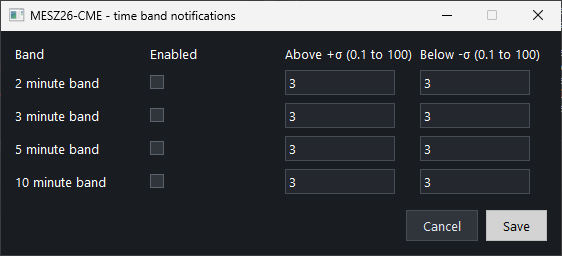
Time band notifications dialog

Global notifications

One shared threshold for every instrument, set from Global notification settings in the console. Global alerts watch the line each tile reads on the primary window, and appear in the Global notifications log at the bottom of the console:

15:53:34 BTC-USDT Total Flow crossed +3.0σ (+4.3σ) (5m)
15:54:02 ETH-USDT Placement Flow crossed -3.0σ (-3.4σ) (5m)
15:54:40 SOL-USDT Buy Line crossed +3.0σ (+3.5σ) (5m)

Global notifications in the console
Setting Meaning
Global alerts for each tile's line Turns global alerts on or off. Off by default.
Global threshold (standard deviations) The σ level that triggers a global alert.
Minimum alert interval per band (seconds) Quiet period before the same band can alert again. Saving new thresholds re-arms the bands, so a band can alert at once on its new threshold. Default 60.
Notification sound (global and ticker alerts) Sound for both kinds of alert. Works while the console is hidden.

On Sierra Chart

  • The default global threshold is 3σ.
  • Every alert line in a tile's log also goes to Sierra Chart's Message Log, as Pulling & Stacking BTCUSDT_PERP_BINANCE: 15:53:31 ALERT 5m Total Flow crossed +3.0σ (+3.4σ).
  • There are no alerts over bars from before the study started: the indicator draws nothing there.
  • After a pause (the licence released or not reachable) or a stale period, each band is armed again. A reading that is still beyond its threshold then alerts once more, although it never came back inside it.
  • The minimum alert interval runs on this computer's clock. If the clock is set back by more than 5 seconds (for example by Windows time synchronization), the interval starts again, so a band can alert again sooner, and the Message Log says this computer's clock moved back ... seconds, so the minimum alert interval starts again.

Next: Sierra Chart settings

Chart images. The chart images on this site show the indicator's display on market data, to explain what it draws. They are not trading results or trade recommendations, and the risk and hypothetical performance disclosures above apply to them. We publish no trading performance. The full text is on the disclosures page.

← Indicator statesSierra Chart settings reference →

Order flow decomposed into one normalized signal. On Bookmap, MotiveWave and Sierra Chart.

contact@stacksignal.com
ProductOverviewPricingBookmap MarketplaceContact
DocumentationStart hereSignalsStates & alertsSettings referenceUpgrading from 2.xMethodology
ForWho it is forBookmapMotiveWaveSierra ChartOrder-flow traders
LegalPatent markingPrivacy policyIndicator privacy policyDisclosuresTerms of Sale

Risk disclosure. Futures and forex trading contains substantial risk and is not for every investor. An investor could potentially lose all or more than the initial investment. Risk capital is money that can be lost without jeopardizing one's financial security or lifestyle. Only risk capital should be used for trading and only those with sufficient risk capital should consider trading. Past performance is not necessarily indicative of future results. The possibility of profit is not equal to the possibility of loss: losses can be larger than any gains, and you can lose more than you invest.

The Pulling & Stacking Indicator is an analytical tool. It does not provide investment advice or trade recommendations, and nothing it displays is a signal to buy or sell.

Hypothetical performance disclosure. Hypothetical performance results have many inherent limitations, some of which are described below. No representation is being made that any account will or is likely to achieve profits or losses similar to those shown; in fact, there are frequently sharp differences between hypothetical performance results and the actual results subsequently achieved by any particular trading program. One of the limitations of hypothetical performance results is that they are generally prepared with the benefit of hindsight. In addition, hypothetical trading does not involve financial risk, and no hypothetical trading record can completely account for the impact of financial risk of actual trading. For example, the ability to withstand losses or to adhere to a particular trading program in spite of trading losses are material points which can also adversely affect actual trading results. There are numerous other factors related to the markets in general or to the implementation of any specific trading program which cannot be fully accounted for in the preparation of hypothetical performance results and all which can adversely affect trading results.

Chart images. The chart images on this site show the indicator's display on market data, to explain what it draws. They are not trading results or trade recommendations, and the risk and hypothetical performance disclosures above apply to them. We publish no trading performance.

Virtual currencies. Some chart images show cryptocurrency instruments. View CFTC advisories, as they contain more information on the risks associated with trading virtual currencies.

Trademarks. Stack Signal™ and Pulling & Stacking™ are trademarks of Stack Signal. Bookmap, MotiveWave and Sierra Chart are trademarks or registered trademarks of their respective owners. Stack Signal is not affiliated with, sponsored by or endorsed by those owners.

© 2026 Stack SignalPulling & Stacking Indicator: U.S. Design Patent Nos. D1,099,944 and D1,100,945 (stacksignal.com/patents/)

We’d like to set analytics cookies to measure which pages traders actually read. Nothing non-essential is set until you choose. No advertising trackers, ever. Privacy policy

Cookie preferences

Choose what we may set

You can change this at any time from “Cookie preferences” in the footer. Declining costs you nothing: the site works identically either way.

Strictly necessary

Keeps the site working and records this very choice. Cannot be switched off.

Always on

We set no advertising, retargeting, or cross-site tracking cookies, and we honour a Global Privacy Control signal automatically. Full cookie list in the privacy policy